Pertinent Perils, a blog by Donna Childs, building a community of resilient small businesses


Archive for the ‘Recovery’ Category

Sep42010

SBA Recovery Loans Perform as Predicted

On March 23 of last year, I posted a blog entry critical of the America’s Recovery Loan Program of the U.S. Small Business Administration. Specifically, I wrote that to mitigate the moral hazard risk (inherent in raising federal government loan guarantees), the SBA stipulates that the loans “are to be extended only to ‘viable’ small businesses, which it defines as those that have ‘demonstrated an earnings history and a proven record for success that may just need a little extra help to get through a short-term downturn’. (Shouldn’t all loans be limited to ‘viable’ businesses? And how did the SBA determine that the current economic downturn will exist only for the ‘short-term’?)”

On June 17, 2009, I posted a follow-up entry to write that there may be relatively few qualified applicants to apply for this program given its unusual requirements and that banks would not likely find the 2 percent premium paid by the government sufficient compensation for the onerous underwriting requirements.

Here we are a year later. The Recovery Loan program expires this month and the SBA has approved just fewer than 8,300 loans, even less than the modest number (10,000) of loans that the SBA had funds available to support. The New York Times has reported that meeting the “struggling but viable” criteria proved difficult for small businesses and banks had little appetite for the extensive underwriting requirements. When you contrast this lame “recovery” program with the Troubled Assets Relief Program (TARP) that bailed out Wall Street, it makes it clear where Congress’ priorities lie.

Jul262010

Helping the Gulf Coast Tourism Industry

Importance of Leisure

Importance of Leisure

The U.S. Travel Association reports that as many as 400,000 travel industry jobs could be lost as a consequence of the oil spill in the Gulf Coast. The total potential cost of the spill to the Gulf Coast tourism industry is estimated at $22.7 billion with most of those losses, as much as $18 billion, likely to occur in Florida. “Travel is a perception business and the impact of disasters like the BP oil spill on the industry is actually predictable,” said Roger Dow, president and CEO of the U.S. Travel Association in a press release. “We know from this research that the oil spill will have long-term effects on businesses and jobs in the Gulf Coast region unless we counteract the usual course of events with an unprecedented response.” The U.S. Travel Association is calling for a $500 million marketing campaign to encourage tourists to return to the Gulf.

Although I oppose spending federal government money to market and promote any industry, I do agree that it makes sense for the U.S. Commerce Department to create travel-related trade missions to encourage international tourists to visit the Gulf. That could certainly be done at low cost. The risk of advocating for tax credits to promote Gulf Coast tourism is that the effort could take tourist business from other parts of the U.S., thereby undermining broad public support for Gulf Coast rebuilding. The high unemployment rate hurts the tourist industry everywhere; unfortunately, the oil spill exacerbates this weakness for the Gulf of Mexico.

Jul192010

Another Blow to Louisiana

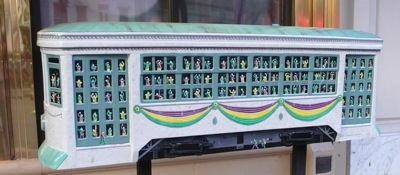
New Orleans Streetcar Art

New Orleans Streetcar Art

There is never a good time to lose 5,000 jobs, but for Louisiana, the news that Northrop Grumman Corp. will close its Avondale shipyard (near New Orleans) could not have come at a worse time. Industries critical to the state’s economy – oil and gas, tourism, fishing – are devastated by the oil spill. Now with the closure of shipyards, the manufacturing industry comes under pressure as well. The 5,000 jobs to be eliminated include engineers, welders, pipefitters and other manufacturing positions that paid annual salaries of $62,000, on average. New Orleans is also facing hundreds of job eliminations at the Michoud Assembly Center, which employs workers from Lockheed Martin. The closures are the consequence of economic pressure for cost efficiency, unrelated to the oil spill. But the consequences are far-reaching as entire service industries support these facilities. In Lower Manhattan, we are all too familiar with this phenomenon: the financial crisis in the fall of 2008 resulted in substantial reductions in the New York banking workforce which, in turn, crippled small businesses that served those workers. You need only see the restaurant closings in the neighborhood to appreciate the ripple effect of the pain. And as we also know from our experience in New York, when a Fortune 500 company leaves, it typically transfers its financial support to other local charities in the communities where it maintains a presence. Reductions in the presence of Fortune 500 companies in New York impacted local charities that depended on those companies for grant support. What I find so upsetting about the experiences of communities facing disasters is that there appears to be no national learning taking place. We suffer needless pain, over and over again, as we experience the same losses from one community to the other. For a country with the diversity and richness of experience as ours, this is unacceptable.

Jul162010

New Ban on Offshore Drilling

The residents of the Gulf Coast states remain in limbo as their economic future will once more be debated in court. After its ban on deepwater offshore drilling was struck down by a Louisiana judge, the White House imposed an even more extensive ban. The original moratorium banned deepwater drilling, defined as drilling in waters of more than 500 feet in depth. The courts struck down the ban on the ground that it was arbitrary and exceeded the scope of executive authority. The new moratoriums imposed by Interior Secretary Salazar, acting on behalf of the Obama administration, applies to any deep-water floating facility with drilling activities, irrespective of depth. The ban imposes considerable hardship on the Gulf Coast states, as the local economy depends upon the oil industry. CNN estimates the oil industry in the Gulf Coast to contribute $150 billion annually to the local economy, well in excess of the tourism industry. And of course, this ban comes at a time when the fishing industry is already suffering the consequences of the oil spill. Public concerns about risk management protocols must be addressed, but an outright ban fails to do that while imposing considerable hardship on communities that are already suffering.

Apr82010

Resilience is the Key to Success

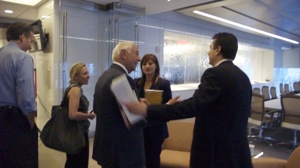
Reception

Reception

This evening I attended a wine and cheese reception at the offices of Inc. magazine to hear Maria Bartiromo speak about her new book, The Ten Laws of Enduring Success. Inc.’s new headquarters are located at 7 World Trade Center, the building constructed by private funds. Towers 1 and 2, dependent on public monies, are still holes in the ground as political gridlock has paralyzed the development process. It was bittersweet for me to be back in that area. Bartiromo’s book begins with the events of 9-11, noting the irony that her birthday falls on September 11 and had been a joyful date. But the tragic events of that date and the financial crises and economic recession that followed led many to question the meaning of success. This led to her book, identifying ten laws of success, including resilience. Certainly that is the critical characteristic in these challenging times. I enjoyed the discussion and of course, it was nice to reconnect with friends at Inc. magazine. Do check out the Comcast Productivity@Work promotion with Inc. magazine. I look forward to providing business continuity audits to the winners.

Jan262010

At Last?

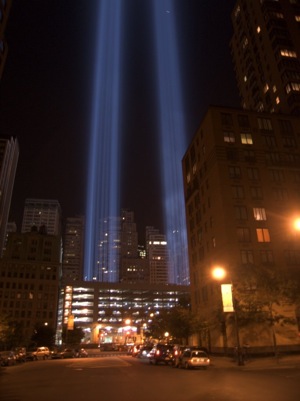
Not the Light at the End of the Tunnel

Not the Light at the End of the Tunnel

Over eight years of negotiations over the fate of the former Deutsche Bank Building may be coming to an end. The building, located at 130 Liberty Street, faces the World Trade Center and became a serious environmental hazard on September 11, 2001. Now the Lower Manhattan Development Corp. (LMDC), established to oversee the reconstruction of the community following the terrorist attacks, may be close to resolving the expense of the building’s decontamination. Since 9-11, the building has been covered by a dark tarp to limit airborne contaminants of soot and ash released when the World Trade Center burned to the ground. Community activists opposed the proposed demolition of the building for fear of health effects to the local residents. Instead a compromise was negotiated: a staged decontamination and demolition process. But the process appeared jinxed as it dragged on for years, marred by horrific accidents and costly delays. In 2007, a fire broke out in the building, claiming the lives of two firemen. The building contractor admitted to wrongdoing in respect of its practices. The delays caused the costs of building decontamination to reach in excess of $200 million, provoking protest from the building’s insurers. The insurance companies have an excess of loss agreement in place to cover the decontamination costs. But the manner in which those costs have escalated necessarily gives rise to disputes over payments due. The LMDC and the insurance companies are reportedly close to concluding a financial settlement. Now comes the next round of disputes: what to do with any payments in excess of building remediation costs? Various groups are lobbying for their share of the spoils. Imagine what misery continues to exist for the residents and small businesses of disaster-ravaged communities who just want to put the tragedy behind them and get on with their lives.

Apr192009

The Tragedy That Never Ends

Something of Substance

Something of Substance

For the small businesses that are based in Lower Manhattan in the vicinity of the World Trade Center site, and for the families that also live there, there is no end in sight. The ongoing reconstruction of the site, the round-the-clock noise and disruptions and concerns about environmental hazards (coupled with an extraordinary process for the demolition of 130 Liberty Street, the office building opposite the WTC) should have ended years ago. The endless and inexplicable delays prolong emotional trauma that should be healed and needlessly disrupt lives. It is an abuse of the residents and small businesses and an abuse of the American taxpayers who are underwriting this farce. Today there was another unwelcome but not, given the history, unexpected, development.

The Associated Press cites anonymous sources within the Port Authority of New York and New Jersey, the government agency which owns the World Trade Center site, that construction of two of the three towers planned for the site may be delayed for more decades, possibly until the year  2030. The delay is attributed, in part, to conditions in the real estate market. Of course, these market conditions would not be pertinent had the reconstruction proceeded in a more efficient manner: the site would should have been redeveloped years before the collapse of the credit markets at the end of 2008.

The other sad irony, that was not cited in the AP report, is that the various subsidies offered to real estate developers, such as Liberty Bonds on a tax-advantaged basis, probably undermined market forces in a way from which Lower Manhattan is unlikely to recover. The various corporate welfare programs incented developers to flip from commercial to residential properties. I am not a big believer in “if you build it, they will come”. Rather, I would see an entrepreneurial opportunity in response to market demand. If you think that there is a demand to live in the financial district, go there and try to buy a newspaper on the weekend or find a decent restaurant that is open late at night. In any event, the developers responded in a rational way by taking the incentives. Many small businesses, such as my own, that were successful were displaced to make way for these grand scheme projects, that now sit vacant.

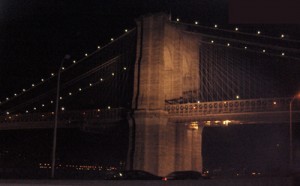
Large downtown employers in the financial district (such as Lehman Brothers and Merrill Lynch) no longer exist and others (AIG) are in trouble. With fewer jobs available in the financial district, and no other reason to live there unless you are an investment banker who works 100 hours a week in that neighborhood, there is little demand to buy apartments. There is such too much uncertainty about employment in that community and mortgage financing is harder to access. I made the decision to move out of our Wall Street office with very little enthusiasm. I miss that community. But now I am glad I did. The photograph, by the way, is one I took of a more enduring symbol of New York. I snapped a picture of the Brooklyn Bridge illuminated at night from my seat in a taxi cab as we were driving down the FDR. I find it to be a more optimistic picture than that of Wall Street now, with its chain retailers, it has lost its character.


Apr132009

No Thanks, We’ll Take Care of It Ourselves

We'll Restore Access Ourselves

We'll Restore Access Ourselves

Polihale State Park on the Kauai Island of Hawaii has been closed since last December when severe flooding destroyed the access road to the park and damaged other facilities. Hawaii’s Department of Land and Natural Resources estimated that it would cost $4 million to repair the road and other facilities and that it would likely take two years to secure the necessary funding and complete the work. The delays threatened the existence of the small businesses that rely on park access, such as small businesses that operate kayak tours, photography businesses and food service businesses. So the affected small businesses and local residents contributed machinery and manpower and began and completed the repair work within eight days - for free. When I read of their extraordinary work, it reminded me of the importance of learning from the experiences of our peers in the small business community. In Prepare for the Worst, Plan for the Best: Disaster Preparedness and Recovery for Small Businesses (Wiley, second edition, 2008), I cited the example of small businesses in Europe that relied on access to a local theme park to operate. Their restaurants and other concessions were at risk when the theme park could not recover quickly from a major disaster, underscoring the importance of business interruption coverage. Entrepreneurs in Hawaii came up with an even better solution.

Nov162008

New Orleans Homeowners File Lawsuit

Notice the house markings

Notice the house markings

New Orleans homeowners filed a lawsuit against the Louisiana Recovery Authority, alleging that it discriminates against black homeowners whose houses were damaged by Hurricanes Rita and Katrina. The Road Home Program, administered by the Authority, bases grants on the pre-storm value of the house or the rebuilding cost, whichever is less.

When I read the newspaper’s account of this lawsuit, it reminded me of some news I had heard on the occasion of my last visit to New Orleans: I was told that plaintiff’s attorneys were seeking to bring suit against federal disaster relief agencies on the grounds that the post-disaster aid to small businesses in the Gulf Coast was significantly less than that that awarded to Lower Manhattan small businesses in the aftermath of 9-11. If true, this rests on a serious misunderstanding of what aid was actually made available to Lower Manhattan small businesses.

But the more troubling aspect of this approach, for the small business community if not for homeowners, is how it delays the recovery process. A study of small businesses in the immediate vicinity of the World Trade Center at the time of the 1993 bombing found that of those small businesses that could not get back online within five business days, 90% were out of business one year later. Cash flow is critical to a small business, which is why you either recover quickly or you don’t recover at all. Perhaps this explains why homeowners are more likely than small business owners to litigate claims following a disaster.

Sep242008

Leveraging Strength for Ike Evacuees Returning to Galveston

Welcome home

Welcome Home

Evacuees returning home to Galveston are just now seeing the devastation inflicted on their homes and businesses by Hurricane Ike. Undoubtedly, they are feeling overwhelmed by the recovery process ahead of them. Having been through a version of that process myself, I can offer words of hope and advice.

First, leverage the strength of your insurance company. Let me explain how that can work in your favor. I returned home to my apartment in the shadow of what used to be the World Trade Center after our neighborhood was closed and evacuated on 9-11-01. For several months I had been homeless as our neighborhood remained under the control of the National Guard, although during that time period, I was once allowed to return home for a half-hour, with a Guardman, to retrieve some personal effects. The Guardsman took neighbors into apartment buildings (once we produced our New York driver’s licenses proving our residency) in groups of five or six. When I came back for good, I contacted an environmental remediation company to remove the soot, ash and other contaminants from my home and my office. The project manager with whom I had spoken said that it would be “months” before he could send a staff person to my property to give me an estimate to perform the work, let alone actually start the work.

I asked if someone could come in the evening, after business hours. The answer was no. I asked about early mornings, before business hours, or on the weekend. The answer was no and no again. With relatively few companies certified to do this work and many thousands of people demanding these services, the queue was very long. And yet this was the critical task before I could safely return home. So I called my insurance company. I hoped that this would be the only major disaster that I would ever have to work through and I would never have to deal with an environmental remediation company again. But insurance companies deal with environmental remediation companies all of the time. They approve payment for these services for their policyholders. They can choose remediation companies as their preferred vendors for certain types of work. So the insurance company had the leverage that I did not.

I explained to the person who answered my insurance company’s CAT line (”CAT” is insurance speak for “catastrophe”) my situation and reminded her that the longer it would take to remediate my home, the longer I could remain in a hotel, which expense was covered by my homeowner’s insurance. She got the point. A few minutes after we concluded our conversation, my cell phone rang. It was the project manager from the environmental remediation company, the same man with whom I had spoken only minutes ago. He advised me to be at my apartment at 7:00 a.m. the next morning so that I could let his team in. At the time I was displaced, I was staying in Jersey City across the Hudson River from Manhattan. Most people commute to Lower Manhattan from Jersey City by the PATH train, but with the World Trade Center PATH train terminus destroyed, we had to take ferry routes that were put in place on an emergency basis. The routes and timetables changed from day to day, as the recovery was underway, so it could take some time to get from where I was staying to my home. Obviously, the project manager didn’t want to waste a trip to my apartment if I could not be there. “Oh,” I said, “you can have someone visit and give me an estimate tomorrow morning?” No, he answered, the insurance company called him on my behalf and he would have a team there to do the cleaning at 7:00 the very next morning.

Some of my neighbors spent months dealing with long waits and negotiating their spot in the queue. This is why you pay for insurance, so get full value for it. By the way, I recommended this tip to someone whose mother lived in Florida through the 2004 hurricane season when she was in the same situation (months and months to get an estimate before any work could be done). He reported that it worked for her as well. Another lesson I learned from 9-11 is that vendors often present the worst-case scenario in terms of service restoration because they would rather err on the side of caution. Then, of course, they look like heroes if they can restore service in a more reasonable time frame. I remember contacting my telecommunications provider to find out when landline service would be restored and was told that it could take months. It was back within two weeks. Bear this in mind when vendors are giving you bad news and don’t let it discourage you.

By the way, the photograph you see here is of the lobby of my apartment building upon our return home when civil authorities re-opened our building. It was quite an experience to return home after an absence to see what had happened to our neighborhood. This is undoubtedly the stress that residents in the footprint of Hurricane Ike are now experiencing.

Prepared Small Business, from paralyzed to prepared.