The residents of the Gulf Coast states remain in limbo as their economic future will once more be debated in court. After its ban on deepwater offshore drilling was struck down by a Louisiana judge, the White House imposed an even more extensive ban. The original moratorium banned deepwater drilling, defined as drilling in waters of more than 500 feet in depth. The courts struck down the ban on the ground that it was arbitrary and exceeded the scope of executive authority. The new moratoriums imposed by Interior Secretary Salazar, acting on behalf of the Obama administration, applies to any deep-water floating facility with drilling activities, irrespective of depth. The ban imposes considerable hardship on the Gulf Coast states, as the local economy depends upon the oil industry. CNN estimates the oil industry in the Gulf Coast to contribute $150 billion annually to the local economy, well in excess of the tourism industry. And of course, this ban comes at a time when the fishing industry is already suffering the consequences of the oil spill. Public concerns about risk management protocols must be addressed, but an outright ban fails to do that while imposing considerable hardship on communities that are already suffering.
New Ban on Offshore Drilling
July 16th, 2010Small Business Lessons from the SEC Settlement
July 15th, 2010The Securities and Exchange Commission announced this afternoon that it had reached a settlement agreement with investment bank Goldman Sachs in connection with fraud charges it had filed in April. There is a lesson here for small business owners about electronic file management! Earlier this year, the Congressional Financial Crisis Inquiry Commission subpoenaed Goldman Sachs to produce certain documents to inform the Commission’s investigation into the causes of the 2008 banking sector meltdown. The Commission is to issue a report of its findings in December. Goldman complied with the subpoena and then some, by turning over 2.5 billion documents, which enraged Commissioner, and former California Treasurer, Phil Angelides. “We did not ask them to pull up a dump truck to our offices to dump a bunch of rubbish,” said Angelides. “We should not be forced to play ‘Where’s Waldo?’ on behalf of the American people.” The Hill mocked the Commissioner’s reaction, asking if he really thought that Goldman would just “pick out the documents that make it look like it caused the crisis and perhaps even highlight the really damning stuff in yellow.”
I suspect that the ability to comply so readily and so generously with subpoenas likely tipped the negotiations in Goldman’s favor. Back in 2005, I had occasion to speak at a small business protection event sponsored by Hewlett-Packard and Agilysys in San Diego. John Hinkle and Chris Fulton of Agilysys shared their observations of plaintiffs attempting to motivate quick, default settlements on civil claims against corporate defendants that could not furnish subpoenaed documents in a timely manner. On the other hand, those that had their electronic files in order and could comply immediately found that the suits against them were often dropped. Why? Because the plaintiffs lacked the resources to play “Where’s Waldo?” with vast quantities of the files and documents that they themselves had demanded. So protect your business by making sure your documents are backed up, online and offsite available for quick retrieval. This practice will protect your business against legal threats as well as physical hazards.
Continuing Heat Wave Results in Higher Energy Bills
July 14th, 2010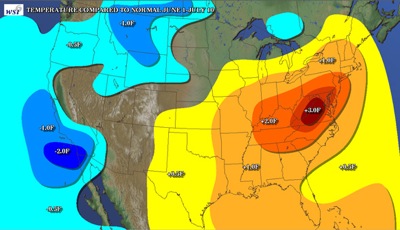
Scorching!
WSI, a Weather Channel company, expects most of the U.S. to be, on average, warmer than it has been over the past 30 years. This forecast for prolonged heat suggests both increased energy usage and an even more active hurricane season. “A new La Nina event continues to rapidly evolve as we head deeper into summer. This will favor more heat across the northern US as the summer progresses,” said WSI Chief Meteorologist Dr. Todd Crawford. “In the Atlantic, record warm ocean temperatures also favor warmer-than-normal temperatures across a majority of the US. On the other hand, near-record soil moisture levels across parts of the central and northern Plains, along with a lack of any significant drought conditions in the US, will temper the overall magnitude of the heat. By early July, we expect heat to spread across most of the western US and to persist across the Southeast, while relatively cooler temperatures persist across the north-central and northeastern US. By August and September, we expect the heat to become more widespread across the northern US. For the July-September period as a whole, we are forecasting 836 population-weighted cooling degree days, 7-8% more than last year and about 10% more than the 1971-2000 mean.” Many of us will be revising our budgets for the second half of the year as air conditioning proves to be a larger line item than expected.
FEMA Trailers – the Sequel
July 13th, 2010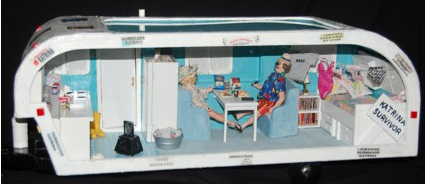
Life Imitates Art
For disaster-fatigued residents of the Gulf Coast, it must be a struggle to move forward with their lives as a painful symbol of the past has returned: the FEMA trailers. The Federal Emergency Management Agency had provided close to $3 billion worth of mobile home trailers intended to be used for temporary housing for Louisiana residents displaced by Hurricane Katrina. Many occupants of those trailers had developed respiratory ailments, which was subsequently attributed to high levels of formaldehyde resulting from the cheap wood and poor ventilation in the units. The government decided to ban the use of trailers for long-term housing.
But the trailers are re-appearing in the Gulf Coast to provide temporary housing for workers involved in the clean up of the oil spill. Because of the $130 million annual cost to store and maintain the trailers, the government elected to sell them in public auctions. Members of Congress had expressed concerns that the trailers would be re-purposed for long-term housing, which fears appear to have been realized. Purchasers of the trailers may not be aware of the health risks associated with the formaldehyde in the trailers or of the ban on their use for long-term housing purposes. But really, what other purpose would the trailers serve if not housing, as they were built with lavatories and kitchenettes? We are long past the time to demand a comprehensive overhaul and accountability from the Federal Emergency Management Agency. “FEMA Trailers – the Sequel” is simply inexcusable.
This photograph is of original art made by New Orleans artist Karen Niklaus. I enjoy art that expresses powerful messages about politics and social change and this piece resonated with me.
FT Headline: “Small Businesses Lose Out”
July 12th, 2010
Poor Marks for Banks
When the lead headline on the front page of the Financial Times announces the crisis in small business capital access, the problem can no longer be ignored. Under the headline “Small business lose out” follows an article summarizing the data presented in the “Terms of Business Lending” survey released this week by the Federal Reserve Bank. The survey collects quarterly data from 348 U.S.-chartered commercial banks and 50 U.S. branches of foreign banks. The survey found that interest rates on small commercial and industrial loans were 3.5% higher than the federal funds rate (the rate at which banks borrow to on-lend to customers), the highest spread since the Fed began the survey nearly 25 years ago. It seems that every policy initiative to motivate large banks to unblock the flow of credit to the small business sector, including the Troubled Asset Relief Program, has failed.
Perhaps this is why the Obama administration’s legislation to create a $30 billion small business lending fund has just cleared the Senate with negligible opposition. To accelerate the bill’s passage, Senate Majority Leader Harry Reid blocked any effort to tack amendments onto the bill, limiting the Congressional debate to the matter at hand. The fund would offer reduced capital costs to community banks commensurate with their growth in small business lending – a carrot that was missing in TARP. Other restrictive elements of TARP, such as preferred warrants, are not part of this legislation, which should speed its passage. But if banks continue to believe that small businesses are poor risks in this recession, the carrots might not have the desired effect.
Flooding in the Rio Grande
July 11th, 2010In 2007, I had the great experience of visiting Laredo, Texas, a community on the Mexican border, for the purpose of delivering disaster preparedness workshops with the San Antonio Small Business Development Centers. Over the past several days, Laredo has experienced extreme flooding as the water levels of the Rio Grande River rose to 42 feet. As of today, the levels are back down to 30 feet, as residents await a decision as to whether disaster aid will be made available to their community. Sadly, many of the affected residents were without flood insurance that costs, on average, $1500 annually in that community. It is particularly difficult in this recession for small businesses and families to budget for expensive insurance coverage until they learn the costs of being uninsured. I will post alerts to this blog as soon as private fundraising initiatives are announced for those who wish to contribute. Laredo is not a wealthy community and needs our support.
Fail Early
July 10th, 2010
Time to Re-Think
“Fail early, fail often” is the mantra of software developers. When writing code, the sooner a programmer discovers an error, the sooner he can correct it. Delaying production until perfection can be achieved guarantees a product that is obsolete by the time it reaches the market. But as I have discovered, learning to fail is hard. Think about your experiences in elementary school – no student raises his hand unless he is sure he knows the answer. We are socialized to believe that correct answers are what matter: tick the box, get a good grade, move along. And so it is a struggle to set aside what we have been socialized to do to accept failure for the gift that it is. But children of other cultures undergo a very different socialization process. Stefan told me that when he was in college and in graduate school, the engineering faculty assigned problems to students that they knew had not yet been solved. They evaluated the quality of the thinking and reasoning, not the correct answer. When I was in college, and I, too, was a science major, the faculty would award partial credit for showing your work, but the grade was dependent of a correct answer. Our educational institutions are becoming anachronisms of an age where students were socialized for post-graduate employment in large institutions. We need more creative thinkers and more risk takers. It is time to re-evaluate the lessons we teach our children. We are doing them a terrible disservice to impose upon them the educational system we inherited.
Heat Wave Saps New York City
July 9th, 2010
Triangles Indicate Brownouts
With temperatures soaring past 100 degrees, residents of New York City are seeking the shade. Heat wave is the leading cause of weather-related deaths. The current wave has already caused two fatalities. The elderly and the medically vulnerable are most at risk for dehydration and heat stroke. This map shows power outages reported by ConEdison owing to peak demands on the grid from air conditioning systems. To discourage excessive utilization, city inspectors are assessing fines for retail businesses that leave their doors open and blast the air conditioning, to encourage shoppers to come in and cool off. If your business is one where telecommuting is feasible, a heat wave is a good time for people to work from home. Even if your office is located in an area with a reliable power supply, employees still have to commute to and from work where they may be exposed to excessive heat and humidity. Consider your clients and vendors at this time and if you can re-schedule their visits to your office until after the heat breaks, do so. They will appreciate your sensitivity to their well being and comfort.
Painful Symbolism at the Twin Span Bridge
July 8th, 2010
A Critical Route
Tar balls from the oil spill in the Gulf of Mexico have entered Lake Pontchartrain where they have been seen as far away as Slidell, a community west of the Twin Span Bridge. The barges placed at the Rigolets were apparently unable to stop the advance of the tar balls; workers have removed more than 1,500 pounds of the oily waste from the lake. Local officials believe that dispersants pushed the tar balls under water, which then advanced and resurfaced past the protective wall of the barges at the Rigolets. Recovery workers may have to reconsider the benefits of using dispersants to break down the oil in the Gulf of Mexico.
Lake Pontchartrain is a robust ecosystem of water life and residents enjoy fishing and crabbing in the area. But beyond the environmental damage, the presence of the tar balls floating past the Twin Span Bridge must be emotionally upsetting for the symbolism. Rebuilding the Twin Span Bridge after Hurricane Katrina destroyed it was a top priority, as it is critical to inter-state commerce. No doubt Louisianans are reliving their most awful days as the tar balls in the lake float past the bridge.
Policymakers Baffled by Small Business Credit Issues
July 7th, 2010
Just Listen to Us
Policymakers continue to be frustrated by their inability to unblock the flow of credit to the small business sector. The President has put forward a $30 billion legislative package to offer incentives to community banks to lend to small businesses. While the measure has passed the House and is on its way to a Senate vote, there are doubts as to the efficacy of the proposed measures to stimulate lending. One critic expressing such doubts is Harvard Law Professor Elizabeth Warren who was appointed by Congress to oversee the $700 billion Troubled Asset Relief Program. In an interview with Bloomberg Businessweek, she stated, “policymakers are flying blind”, owing to a dearth of data on small business lending. While the original intent was that TARP recipients would on-lend some of their capital infusion from Washington to the small business sector, they have clearly failed to do that. The largest TARP recipients, those with assets in excess of $100 billion, reported 10% declines in small business lending from June 2008 to June 2009. (One bank has even offered rate reductions on its loans to small businesses that hire new employees.) But Warren is uncertain if the decline is the consequence of the banks’ reluctance to lend or the reluctance of credit-worthy small businesses to borrow. To remedy the data gap, the Federal Reserve Bank of Atlanta recently began a quarterly survey of small business lending in its region, in the hope that better data might craft better policies.
If we were not experiencing double digit unemployment even as viable small businesses that wish to hire are choked for credit, this would be funny. But what the monetary economists of the Fed and their academic advisors needs to do is to actually talk to a few small business owners. I am very active in entrepreneurial groups and the message I hear everywhere is the same. Those of us who own businesses that are credible candidates for loans are reluctant to borrow for fear of rising taxes, higher costs due to healthcare reform and other areas of uncertainty arising from government policies. Businesses generally prefer stable environments when taking on longer-term liabilities, such as loans. We are not close to having clarity on some very important tax and economic policies (yes, we know taxes will rise, but by how much?) that would enable us to see through the fog to determine how much debt we could prudently take on. This is the message that Washington needs to hear.